As At the World's Edge prepares for its sixth festival and this year's theme, Bounds and Bridges: Beyond the Lines, Festival Director Justine Cormack reflects on the lines that drew AWE together, and the living web of connection they have become.
At the World's Edge celebrates its sixth festival this year. We launched in 2021, when Aotearoa New Zealand and the world were living behind closed borders. Lines were everywhere then: borders, bubbles, boundaries. It might have seemed the worst possible moment to start an international chamber music festival. It turned out to be exactly the right one, because AWE has always been about what happens when a line stops being a barrier and becomes a bridge.
That idea sits at the heart of this year's theme, Bounds and Bridges: Beyond the Lines. A line can bound us, or it can carry us somewhere new: a string under a bow, a horizon at dusk over Lake Wānaka, a thread between two musicians meeting for the first time. When lines cross, and cross again, something remarkable emerges: a web. Delicate, sensitive, surprisingly strong. Six festivals on, that is what AWE has become. A fine web of connection between artists, composers, audiences and communities around the world, alive and still being spun. This year I have found myself tracing its first threads.
Where the first threads were spun
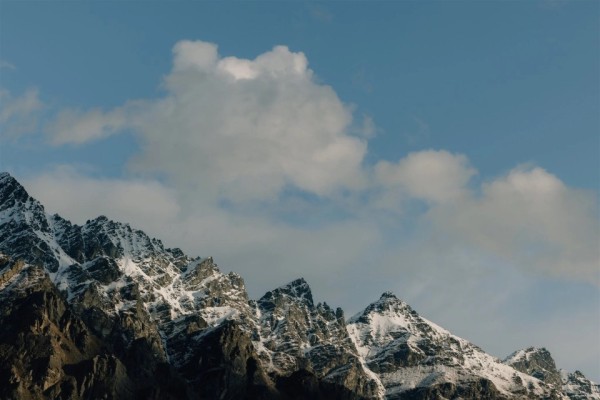
Holding a world-class chamber music festival in Queenstown, Wānaka and Central Otago was a long-held dream of mine. Nature and music have always had a close and intertwined relationship, and you only need to look at the landscapes around us to understand why. In 2017, Benjamin Baker was one of the six semi-finalists at the Michael Hill International Violin Competition. For that semi-final round, each of them performed a Mozart String Quintet, and I was the second violin. So the very first time Ben and I played together, we were playing chamber music, and we felt a great affinity towards one another. I soon discovered he had held the same dream, and for even longer. Call it fate, call it serendipity. Whatever it was, two lines crossed, and the weaving began.
The rooms, alive with sound
Our four festival venues are Rippon Hall, The Shed at Cloudy Bay, Bannockburn's Coronation Hall and Te Atamira. Each is intimate and utterly distinctive, drawing audience and musicians into a closeness that can only happen in rooms like these. Many of our Festival Artists are accustomed to large concert halls, so performing here is a revelation for them too. And then they look out of the windows. The Remarkables, Lake Wānaka, the Pisa Range. To perform in spaces that have the acoustics and the outlook is, quite simply, awe-inspiring.
Each room is another instrument that plays directly into the impact of the sound and the potential for the music to connect with our audiences. When a room's acoustics are generous, it is hugely inspiring for the musicians too. That matters to us just as much. We craft each programme to its venue, and in those final rehearsals we often make last-minute adjustments, tailored to the room. The place is never a backdrop. The acoustic is a valuable and generous thread in the audience's experience, part of the performance itself.
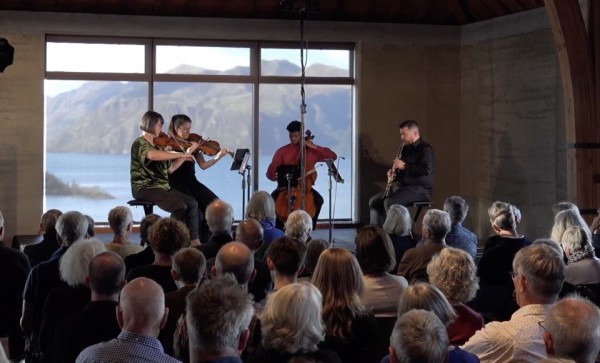 A thread begins: Eve de Castro-Robinson's Earth's Eye at AWE 2024, with Bryony Gibson-Cornish (NZ/UK), Julian Bliss (UK) and Sterling Elliott (USA).
Spinning new threads
Playing with new and different people is one of the most inspiring things a musician can do, and we are very thoughtful about each year's team: who we bring together, and how. Many of our Festival Artists meet one another for the first time at AWE. Over the festival they live, eat and rehearse alongside each other, and around the table an emerging New Zealand musician discovers that a world-class performer is simply a colleague. But the real magic happens when we take up our instruments. It is in the playing that the web comes to life: musicians weaving in and out of each other's work in every combination imaginable, listening, responding, spinning new threads with sound itself. It's intense, it's alive with possibility, and it's wonderful.
Composers are woven into this web too. With NZTrio I was involved in commissioning close to forty new works, and that commitment to living music runs right through AWE. This year we welcome Michael Norris as our Composer in Residence, his music threading through the festival, while our Emerging Composer's work is shaped, rehearsed and premiered in the company of the very artists performing it. When a composer sits in the room while musicians bring their notes to life, the line between page and stage dissolves.
The audience, in the room
A living web is never still. When one strand sounds, every strand shimmers in response. That is precisely what happens in performance. One of the joys of chamber music is that pieces take on new meaning every time they're played, and trust built through the week becomes daring on the stage. For our audiences, this is an experience that cannot fully be explained. You have to be in the room, feeling that particular quality of attention settle around you, connected to the musicians and to everyone listening beside you. And once you have, you're hooked.
The web widens in the festival's second week, which belongs to the region's young people. Our Emerging Artists, Emerging Composer and Festival Artists travel to early childhood centres, primary and secondary schools across the district, spinning the very first threads between chamber music and its next generation of listeners and players.
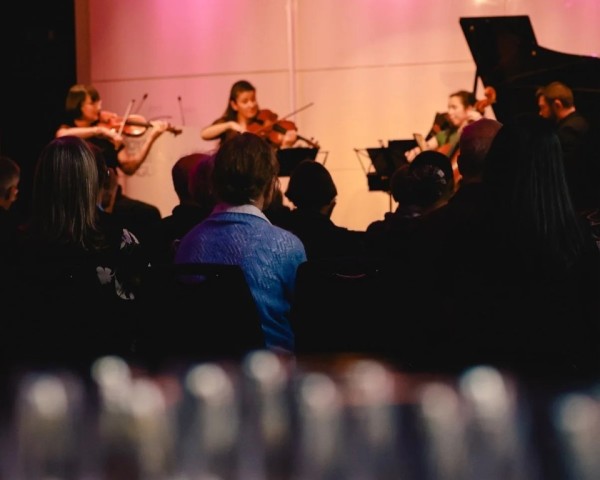 The same threads, re-woven in London: sharing Eve de Castro-Robinson’s Earth’s Eye with our audience there in 2025, again with Bryony and Julian, and this time with cellist Sinéad O’Halloran (Ireland).
A web across the world
In recent years the web has stretched across oceans, with sister festivals in Chicago and London carrying a taste of AWE and Aotearoa to international stages. We may be far from our festival base, but it all feels familiar as we reconnect with musicians who have made the journey to Aotearoa, eager to take up their instruments and perform with us on their home turf. And these festivals work in both directions: they are where we discover artists with the potential to join us in Aotearoa too. Our artists tell their friends and colleagues about AWE, and one year's Festival Artist has often performed with those from years before. Creativity and community keep passing through the web, and it keeps reaching further.
That, in the end, is its strength. This will always be a fine web. It does not thicken or set. It stays delicate, shining, somehow living: each thread a line you can follow somewhere new. And its anchor point never moves: AWE is rooted in the Southern Lakes and Central Otago, where our core community is. It is where we belong.
- Written By and with thanks to: Justine Cormack / At the World's Edge Festival
Learn more about At the World's Edge festival events on Te Wahi Toi:
- Crossed: Sat 03 Oct - https://www.tewahitoi.nz/whats-on/crossed-at-the-worlds-edge-festival/
- Between: Sun 04 Oct - https://www.tewahitoi.nz/whats-on/between-at-the-worlds-edge-festival/
- Strung: Mon 05 Oct - https://www.tewahitoi.nz/whats-on/strung-at-the-worlds-edge-festival/
- Radiance: Fri 09 Oct - https://www.tewahitoi.nz/whats-on/radiance-at-the-worlds-edge-festival/
- Awe: Sun 11 Oct - https://www.tewahitoi.nz/whats-on/the-line-at-the-worlds-edge-festival/